
Fiber-Optic Drone Technology: How It Works and Why It’s Different
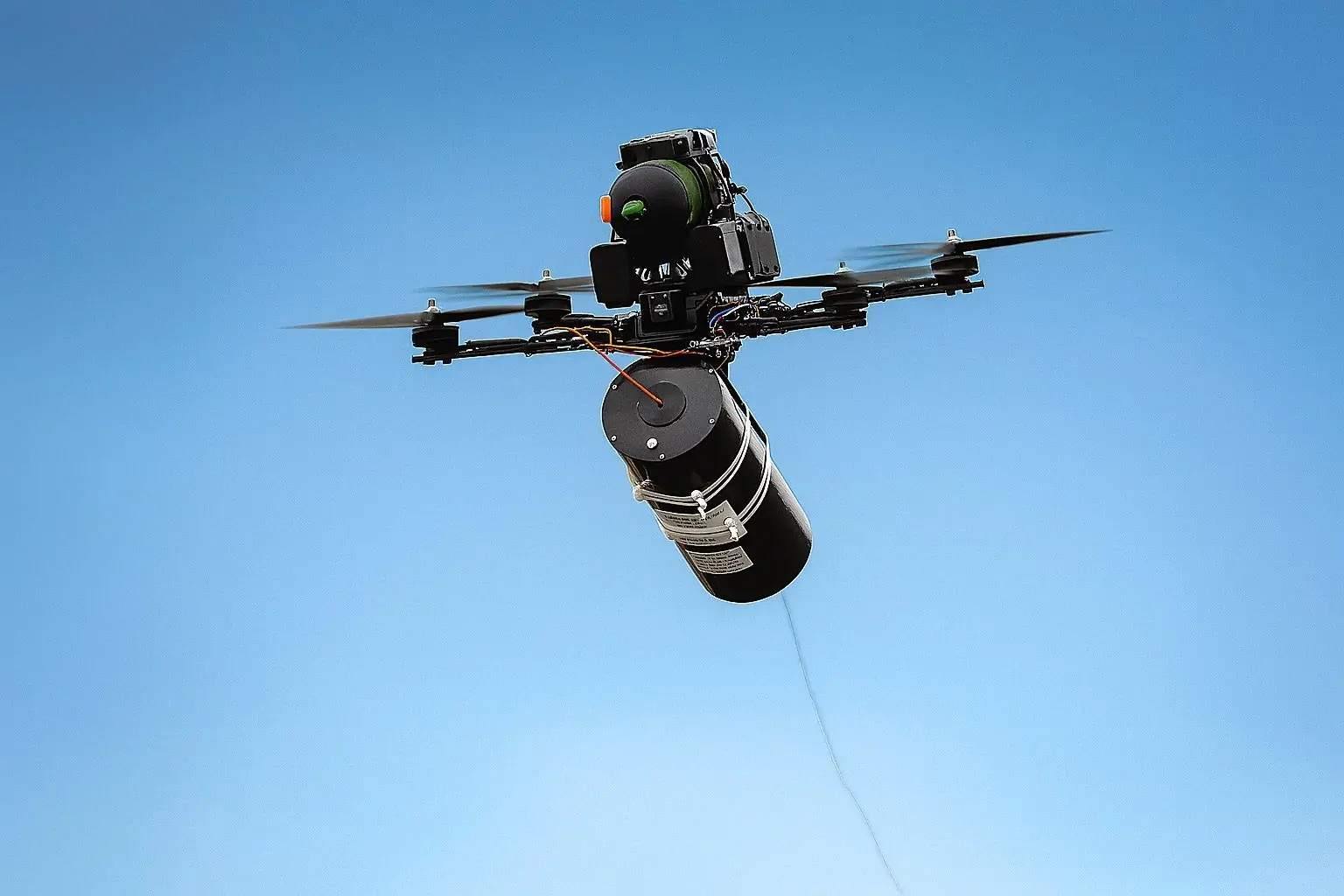
Fiber-optic drones are UAVs that use a physical fiber-optic cable tether for data communication with their operator, rather than relying on wireless radio or satellite links. In practice, this means the drone is either physically connected to a ground control station via a lightweight fiber-optic cable, or carries a spool of fiber that unwinds as the drone flies spotterglobal.com. The fiber line carries control commands and live video feeds encoded as pulses of light, providing high-bandwidth, low-latency communication between pilot and drone. Unlike standard drones that transmit radio signals through the air, a fiber-optic drone’s communications travel inside a cable and emit no radio-frequency (RF) signature. This key difference yields several major advantages:
Immune to Jamming: Electronic warfare units can jam or hijack radio-controlled drones by interfering with their RF signals. Fiber-optic drones, however, “give off no radio broadcast signal… and can’t be jammed”. The cable link is inherently secure and immune to electromagnetic interference, making these drones impervious to traditional jamming and signal interception. On today’s battlefields where electronic jamming is ubiquitous, this is a revolutionary edge.
Stealthy Communications: Because they operate in total radio silence, fiber-tethered drones are effectively invisible to RF scanners or radar systems that detect communication emissions. Troops have found that when these drones are in use, their radio-frequency detectors fall silent – a spooky change that signals a new threat overhead. The drones themselves can still be spotted on conventional radar due to their physical presence, but the lack of any radio signal makes early warning and tracking far more difficult.
High Data Bandwidth: Fiber-optic lines can carry enormous amounts of data at the speed of light. Even an ultra-thin fiber strand (as thin as a human hair) can transmit high-definition video with virtually zero lag. Operators report getting a “perfect video feed right up to the target”, unlike analog radio FPV links which often cut out or turn to static at critical moments. This crystal-clear feed allows for precise manual piloting in complex environments. One Ukrainian pilot noted that after experiencing fiber-optic control, “I never wanted to go back to [regular radio]”.
Negligible Latency: The light-based signals in fiber have minimal delay, meaning the drone responds almost instantaneously to control inputs and the camera feed updates in real-time. This contrasts with satellite-controlled drones (which can have noticeable lag) and even many radio systems. The responsive control is crucial for threading drones through tight urban or wooded terrain.
Operation in RF-Hostile Environments: Fiber-optic control allows drones to be used in environments where radio communication would normally fail – for instance, deep inside reinforced concrete structures, underground tunnels, or dense forests. As long as the physical cable can follow, the drone remains in contact. Ukrainian forces found that fiber drones could “snake through the woods with impunity” to reach targets that were previously safe under radio-dense tree cover. Even indoor hideouts are no refuge now; drones trailing fiber can fly through doorways or windows and maintain control to strike inside buildings.
However, fiber-optic tethering also brings unique challenges and limitations. The most obvious constraint is the physical tether itself. A drone can only fly as far as its fiber allows – typical spools range from 5 km up to 20–30 km in length. Unlike wireless drones that can theoretically be controlled indefinitely (with relays or satellite links), a fiber drone has a hard range cap defined by cable length. The tether also introduces issues of drag and entanglement. A cable unwinding behind a fast-moving drone can snag on trees, power lines, or buildings. Pilots must fly carefully to avoid kinking or knotting the fiber, since a single sharp bend or break will cut the signal and end the mission. Maneuverability is somewhat reduced compared to free-flying quadcopters – sudden sharp turns are hampered by the tether’s pull. The added weight of the spool and a larger battery (to carry both drone and cable) makes fiber drones heavier and slower than their radio counterparts. A typical first-person-view (FPV) racing drone might exceed 150 km/h, but fiber-armed versions usually top out around ~60–70 km/h. This can make them easier targets for small-arms fire if spotted. There are also operational costs to consider: each drone mission leaves behind kilometers of fiber cord strewn about, which is usually not recoverable in combat. This expendable cable (often made of polymer fiber) adds expense – one Ukrainian commander estimated a fiber drone costs about twice as much as a regular model (roughly $1,000–1,200 for a 10 km range unit). Despite these drawbacks, the consensus among operators is that the benefits outweigh the hassles: “Those complications are worth it when a drone flies without trouble, straight into a target,” as one frontline soldier put it.
A Ukrainian first-person-view (FPV) drone configured with a fiber-optic cable spool (black cylinder underneath) during a test flight in Kyiv Oblast, Dec 2024. Such fiber-optic drones carry a thin cable that unspools behind them, enabling jam-proof control and live video feed even through urban or forested terrain. The trade-off is added weight and a tether that can snag, but the tactical advantages have proven decisive.
NAVIGATION
Send Us A Message