
News
Types of Fiber-Optic Drone Systems
Not all fiber-optic drones are built the same. Broadly, we can distinguish two major categories of fiber-linked drone systems:
Tethered Power Drones (Stationary “Aerostats”): In some systems, a drone is literally tied to a ground station by a combined power/data cable. These tethered drones act like aerial elevators – they can hover at a fixed altitude (often 50–300 feet up) for extended durations because the tether provides continuous power from the ground, alongside a fiber-optic data link. Tethered drone platforms have been used for persistent surveillance, acting as temporary “eyes in the sky” or telecom relays. For example, AT&T’s “Flying COW” (Cell on Wings) is a tethered drone that can loiter overhead to provide cellular coverage at disaster sites or large events. The fiber in its tether provides a high-bandwidth backhaul connection, while the power line keeps it aloft indefinitely. These systems essentially function as mobile aerial towers – they are relocatable within minutes and can stay airborne for hours or days. However, tethered power drones are limited in range (they typically stay within a few hundred meters of the ground station) and mobility (often hovering nearly in place). They are vulnerable to weather and cannot chase targets, but they excel at continuous observation or communications in a fixed area, such as guarding a base or providing emergency networks. Many commercial vendors (Elistair, TCOM, etc.) offer tethered drone kits for military base security, media broadcasting, and civil surveillance, which integrate fiber-optic lines for secure data transfer.
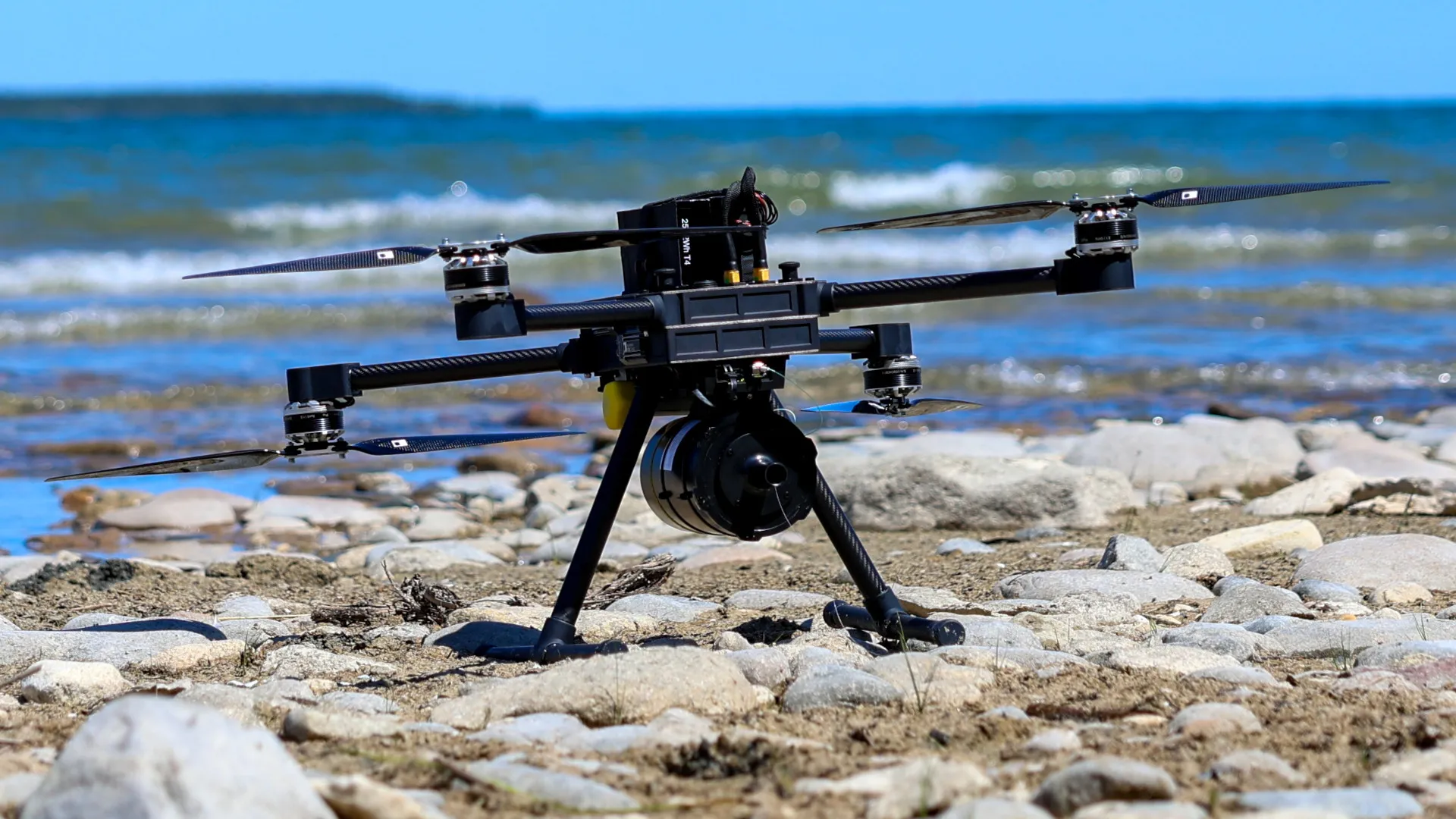
Fiber-Optic Guided Drones (Free-Ranging FPVs): The second type – and the focus of recent conflict – are fiber-optic guided drones that carry a spool of cable on the drone itself. These are often modified FPV quadcopters or small fixed-wing drones equipped for one-way attack missions or tricky reconnaissance. At launch, a full spool (5–20 km of coiled fiber) is attached to the drone, and as it flies toward the target, the cable feeds out behind it. The operator sends control inputs and receives live video through this tether until the drone either strikes its target or exhausts its cable. Essentially, it’s a “wire-guided missile” concept applied to drones – combining human-in-the-loop control with the reliability of a wired link. This approach allows the drone to roam kilometers away from the operator while still avoiding any RF emissions. These fiber-FPV drones are being used as loitering munitions (kamikaze drones) and precision guided recon units on the modern battlefield. Unlike tethered power drones, the fiber-guided drones are usually battery-powered and expendable. They trade persistence for range and stealth: once the mission is over, the cable and drone are generally lost. That makes them suited for high-impact missions like striking enemy armor, cutting off supply lines, or scouting heavily jammed zones. The concept isn’t entirely new – militaries have used wire-guided munitions for decades (for instance, the U.S. TOW anti-tank missile deployed in the 1970s trailed a copper wire to relay guidance signals, and Israel’s Spike LR missile uses a fiber-optic tether for up to 5.5 km of guidance). What’s new is adapting this technique to multi-use drones and mass-producing them for widespread battlefield use. Fiber-guided drones were prototyped only in the last few years but have rapidly moved from concept to combat after proving effective in Ukraine spotterglobal.com spotterglobal.com. Both small quadcopters (carrying 1–2 kg warheads) and larger octocopters or fixed-wings (carrying 5+ kg bombs) have been outfitted with fiber optics for guidance. In Ukraine, “more than a dozen models” of fiber-optic FPVs have been developed domestically, some able to carry up to 3 kg of payload on fiber control. Similarly, Russia has fielded several types of fiber-guided kamikaze drones, often repurposing off-the-shelf FPV designs to carry RPG warheads or other explosives. We will dive deeper into how these are used in combat in the sections below.
In addition to these two main categories, fiber-optic teleoperation is also employed in other domains. Underwater remotely operated vehicles (ROVs) routinely use fiber or tether cables (since radio waves do not travel through water), allowing exploration or explosive ordnance disposal at sea depths. Ground robots can be fiber-tethered as well – an example from Ukraine is a small tracked UGV nicknamed “miniature tank” that delivers supplies to frontline troops via a fiber-optic cable control, sparing humans from exposure to enemy drones. Even in civilian settings, any scenario with an RF-denied environment (mines, tunnels, industrial plants) has long used tethered robots or drones for remote inspection. In essence, fiber-optic control is a solution whenever wireless control is impractical or too risky. The ongoing war has simply turbocharged its development for aerial combat.
NAVIGATION
Send Us A Message