
Future Trends and Implications of Fiber-Optic Drones
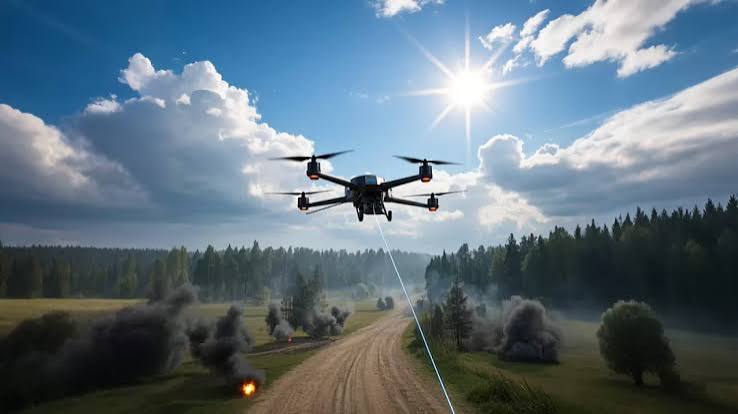
Looking ahead, fiber-optic drones appear poised to influence not just tactics, but broader technological and geopolitical trends. Here are some future developments, implications, and concerns surrounding this technology:
Mainstream Military Adoption: It’s likely that fiber-optic control will be integrated into standard military UAV doctrine. We can expect more armies to equip at least a portion of their drone fleets with fiber-optic capabilities for counter-EW operations. Future tactical units (platoons/companies) might have dedicated fiber-optic drone teams ready to deploy when jamming is detected. Defense R&D may create modular kits that can convert a normal drone to fiber control by attaching a spool and swapping communications modules. In essence, fiber-optic control could become another mode that drones switch to, much like switching frequencies – a drone could launch on radio and automatically flip to fiber mode when entering a high-jam zone (if it’s trailing a cable). Lessons from Ukraine on training and logistics will shape how militaries prepare their soldiers to use and maintain these systems.
Blending Autonomy and Fiber Control: As AI improves, there’s potential to combine onboard autonomy with fiber control for a hybrid approach. For instance, an autonomous drone might navigate to an area on its own (no control link needed, so it can’t be jammed en route), then a fiber link could be engaged for the final attack phase where a human operator takes over to identify the exact target and steer the drone precisely. This would minimize the length of fiber needed (perhaps only last 1–2 km) and reduce risk of early cable snag. Alternatively, AI co-pilots could help fiber drones avoid entanglements – using machine vision to spot obstacles for the tether and adjust path accordingly (as hinted by CommMesh’s note on AI managing the cable to avoid obstacles). The Ukraine war has also spurred talk of AI-driven targeting for these FPVs so that they can identify tanks or vehicles by themselves; combined with fiber, one could have a semi-autonomous loitering drone that only calls home via fiber when it finds a target, sending video for confirmation and receiving the final attack command. Such developments blur the line between loitering munition and guided drone, possibly making these weapons even more effective.
Counter-Drone Technologies Rise: The success of fiber-optic drones will inevitably accelerate the development of counter-drone tech. Radar systems (like those from Spotter Global) that specialize in detecting small, low-flying objects will become standard at military bases and likely at civilian critical infrastructure to guard against terrorist drone attacks. Directed-energy weapons (laser or microwave) may receive more funding, as they offer a way to shoot down drones without expending costly missiles. There’s also research into drone interception – using defender drones to crash into or net rogue drones. Fiber drones complicate that slightly (no easy comms to disrupt), but physically they can be intercepted like any other. Expect to see advanced multi-sensor systems (combining radar, acoustic detectors, infrared cameras) deployed to spot even quiet, radio-silent drones. The war has shown that neglecting the drone threat is not an option, so countries are scrambling to plug the gaps in their air defense down to very low altitudes.
Proliferation to Non-State Actors: A concerning implication is that the same fiber-optic drone concept can be adopted by non-state groups, insurgents, or terrorists. The parts are relatively accessible: a racing drone, some fiber-optic reel, and a camera – plus the know-how to connect them. If such groups face an opponent with jamming equipment (for example, militants against a conventional army), they might copy what they’ve seen in Ukraine. Already, ISIS and others used simple drones in Iraq/Syria for attacks (though they didn’t face jamming then). In the future, we could imagine a scenario where say a terrorist cell uses a fiber-optic drone to try to bypass security at a high-profile event (since many venues now have RF jammers for VIP protection – a fiber drone wouldn’t care). As the Spotter Global article warned, “if fiber optic drones are successful in conflict, they may soon become a weapon of choice for domestic violent extremists”. This raises challenges for homeland security and law enforcement, who may need to detect and stop such drones in civilian contexts. Governments might have to regulate the sale of long-range fiber-optic spool kits or enact laws against unpermitted tethered flight (though enforcement is tricky).
Regulatory and Legal Concerns: The rise of fiber-optic drones will force regulators to catch up. Aviation authorities will need to address tethered drone operations in their rules. Many countries treat tethered drones differently (often more leniently) than free-flying drones, since a tethered drone is confined and seen analogous to a kite or balloon. However, if drones on tethers start going kilometers away (not just straight up from a fixed point), that muddies the regulatory picture. Airspace control will need provisions for long horizontal tethers that could snag low-flying aircraft or foul power lines. There may be requirements to mark tethered drones with streamers or have breakaway cables to minimize risk to other airspace users. On the battlefield side, the legal review of weapons might consider whether fiber-optic kamikaze drones fall under any existing treaties or if they raise any unique issues (likely not beyond what loitering munitions already raise). One specific concern could be the environmental law aspect – as highlighted by CEOBS, the accumulation of non-biodegradable cable debris might violate certain environmental norms or require remediation after conflict. In a post-war context, countries will have to literally clean up miles of discarded fiber. Perhaps future designs will explore biodegradable fiber cables that dissolve after some time to mitigate this.
Longer Term: Merging Communication and Weaponry: Fiber-optic drones hint at a broader theme of merging communication infrastructure with weapon systems. In the future, we might see optical communication networks on the battlefield connecting not only drones but also ground robots, sensors, and soldiers via thin fiber-optic lines for a hyper-secure combat internet. Already, Ukraine’s forces have laid some fiber cables in trenches to network devices without radio. If drones can drop or drag fiber lines between positions, they could even act as deployers of ad-hoc fiber networks, extending secure comms to forward units. There is also the concept of “fiber optic guided munitions (FOG-M)” which could extend to artillery shells or rockets (some experimental artillery shells unreel fiber behind them to provide guidance back to the launcher). The success with drones may revive interest in those ideas.
Continuous Power Tethers in Combat: Another trend could be the return of tethered observation platforms in military use. Fiber-optic drones in Ukraine have all been battery-powered (short flights), because a long dangling power cable would limit mobility. But for static defense, we may see more tethered drones that provide day-and-night surveillance without needing to land, powered from a base via cable (the tether carrying both power and fiber data). Such drones could replace traditional watchtowers or complement radar by giving a live overhead feed 24/7. They’d be vulnerable if spotted, but possibly made very small or silent to avoid drawing attention. Some units in Ukraine reportedly used tethered quadcopters to keep an eye on enemy lines while remaining jam-proof. As power tether tech improves (thin high-voltage wires), these could see wider deployment.
Geopolitical Impact: Fiber-optic drone tech could influence global balances in subtle ways. For instance, countries that excel in electronic warfare (like the US) have always assumed they could nullify an adversary’s drones by jamming. If potential adversaries (Russia, China, etc.) field swarms of fiber-controlled drones, the US will have to adjust by investing more in kinetic air defenses at the small scale. It could diminish the relative advantage the US had with EW in some scenarios. Conversely, the technology could empower smaller nations or non-state actors to pose a greater threat to advanced forces, since jamming is no longer a trump card. We might also see diplomacy around the components: export controls on certain fiber-optic communication modules that could be used in drones, for example. Just as night-vision goggles or cryptographic radios are controlled, perhaps future fiber-optic drone kits will be on export restriction lists to keep them from falling into the wrong hands. However, since fiber optics are so ubiquitous in civilian telecom, that would be difficult to enforce.
In conclusion, fiber-optic drones have rapidly evolved from a niche concept to a frontline staple in less than two years, driven by the crucible of the Ukraine war. They illustrate the endless cat-and-mouse of military technology: as one side exploits the electromagnetic spectrum, the other side quite literally goes under the radar by using a simple cable. This technology brings drones into a new phase – one where control cannot be wrested electronically, only physically. The implications will unfold in coming years as militaries adapt their strategies, industries create new products, and regulators strive to ensure safety and security. One thing is clear: the success of fiber-optic drones in combat has expanded the art of the possible for unmanned systems. The phrase “cutting the cord” is usually associated with progress, but in this case, it is the cord that provides an innovative leap forward in capability. As fiber-optic drones continue to spread, armies and industries around the world will be rewiring – sometimes literally – their approach to drone warfare and drone work in civilian life.
NAVIGATION
Send Us A Message